Acting On Assaults
Transport workers are facing a violence epidemic.

Since the launch of the union’s Action Against Assaults campaign, RMT has employed various strategies to highlight the need to tackle violence against workers and passengers.
RMT has exposed the prevalence of violence and abuse on public transport with evidence from transport workers and official statistics revealing that it is becoming more of a problem.
As part of the campaign the union has surveyed members with shocking results and is demanding additional legal protections for public transport workers.
The extent of this growing violence and abuse stems from several factors, including concerted efforts to implement policies such as Driver Only Operation and ticket office closures that significantly reduce staffing and have made lone working commonplace, putting both passengers and staff at risk.
These attacks on staffing have been accompanied by a lack of action taken against perpetrators and insufficient support from many employers for staff who are victims.
Declining services arising from the fragmented and underfunded transport network and ongoing cuts to British Transport Police and police forces often means that perpetrators often face insufficient deterrents for their unacceptable behaviour.
Trends on public transport also clearly reflect wider trends in the prevalence of anti-social behaviour.
The industrial element of the campaign has focussed on increasing employer action to reduce assaults including ending lone working and minimising late-night working. This has involved supporting health and safety reps and officers to effectively address these issues.
This part of the campaign will also involve work to establish effective arrangements in industry bodies, including the new Great British Railways, to reduce assaults and violence.
Political actions have included campaigning for a standalone offence of abusing or assaulting public transport workers, alongside building alliances with NGOs, women’s groups and disabled people’s organisations.
The union is also campaigning to protect and increase staffing levels and for a reversal of the cuts to British Transport Police.
RMT SURVEY
The union recently surveyed members working across public transport in rail, bus, London Underground, metro, passenger ferry and taxis to ask about their experiences of violence and abuse at work.
Over 6,000 public transport workers found that:
• Nearly two-thirds (63 per cent) experienced workplace violence in the past year.
• Of those, over 85 per cent experienced violence multiple times.
• The most common form of violence was verbal abuse (92 per cent), followed by threats of violence or assault (63 per cent).
• Nearly a quarter had been physically assaulted.
• Members also reported experiencing a wide range of abusive behaviour including being assaulted with weapons; racial harassment; sexual harassment or assault; LGBT+ harassment and being spat at or targeted with bodily fluids.
• Of those who experienced workplace violence, 60 per cent were lone working at the time.
• Nearly 60 per cent had witnessed violent and/or abusive behaviour targeted at passengers.
• 75 per cent of those who experienced workplace violence reported the incident to their employer, but only a third of those were satisfied with their employer’s response to the incident.
• Of those who did not report it, nearly 70 per cent said it was because such incidents are considered ‘part of the job’.
• 70 per cent of members thought that workplace violence had increased in the past year, and just three per cent thought it had decreased.
• 95 per cent of public transport workers support the creation of a standalone offence of abusing or assaulting public transport workers at work.
• 87 per cent of members working in rail, metro and London Underground said that an increase of staff at stations and on trains would help reduce violence.
• Nearly 80 per cent of members would be prepared to take industrial action over workplace violence, if they felt their employer was not protecting their safety.
ASSAULTS FACTS
The experiences of RMT members are backed up by official data. BTP statistics show between 2021 and 2024 there was a year-on-year increase of both violent and serious public order offences against rail staff. In 2024, there were 7027 recorded offences, an increase of 2257 (47 per cent) from 2021.
During 2023/2024 Transport for London recorded 10,493 incidents of work-related violence and aggression, a five per cent increase from the previous year.
Reports of sexual assaults and harassment on trains have also risen by more than a third over the past 10 years, according to data requested by a BBC investigation. There were 2,661 incidents reported across England, Scotland and Wales last year, where one in 10 were children - with some younger than 13.
In its response to the Crime and Policing Bill Committee, the Rail Delivery Group referenced a range of evidence including research by the RSSB from 2021 which found that the prevalence of post-traumatic stress disorder (PTSD) in rail staff was more than double the rate in the general population.
THE CRIME & POLICING BILL
RMT is calling for additional legal protections for public transport workers who are abused or assaulted at work.
Please write to your MP here
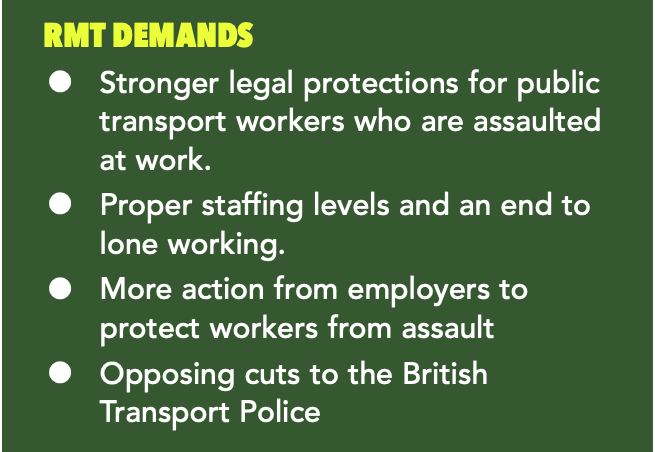
Strengthening legal protections would support workers in reporting incidents, deter perpetrators and improve the rate of action taken against them. In recognition of the risks they face as frontline workers, similar legislation already exists for emergency services workers, and in Scotland legislation also exists for retail workers.
The UK government has recognised the importance of strengthening legal protections for frontline workers and is using the Crime and Policing Bill, currently in the House of Commons, to create a new offence of assaulting a retail worker at work.
RMT has developed a Parliamentary amendment with Rachael Maskell MP which seeks to create a specific offence of abusing or assaulting a public transport worker at work and extend the maximum sentence from six to twelve months.
In Parliamentary debate, Maskell highlighted the impact of violence and abuse on RMT members, including citing previous surveys:
“40 per cent of transport workers who are women have been sexually harassed in the last year…”
SCOTLAND
In Scotland, where this is a devolved matter, RMT has been undertaking activity in support of legislative change. Legislation already exists creating a standalone offence of abusing or assaulting retail workers, and RMT has said to the Scottish government that this existing legislation would cover certain transport workers.
Transport Scotland has convened a working group with the unions, BTP and ScotRail to examine legal protections for rail workers and whether retail-worker protections should be extended.
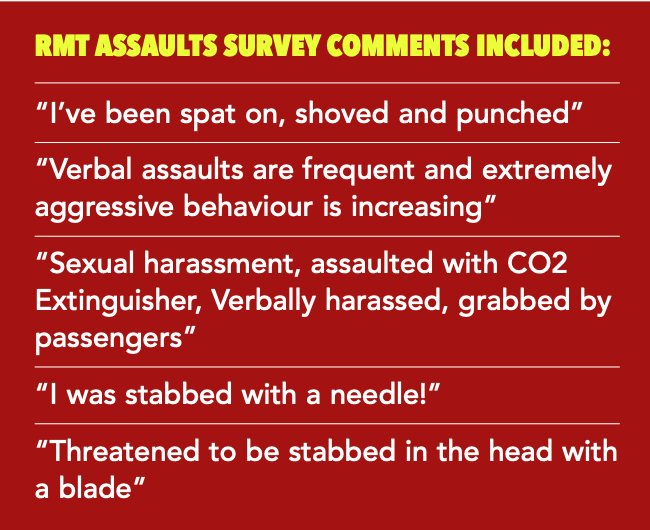
RMT ASSAULTS SURVEY COMMENTS
An RMT News Article - Read the December 2025 edition here

Follow RMT on Bluesky, X, Threads, Facebook, Instagram, LinkedIn, YouTube and TikTok